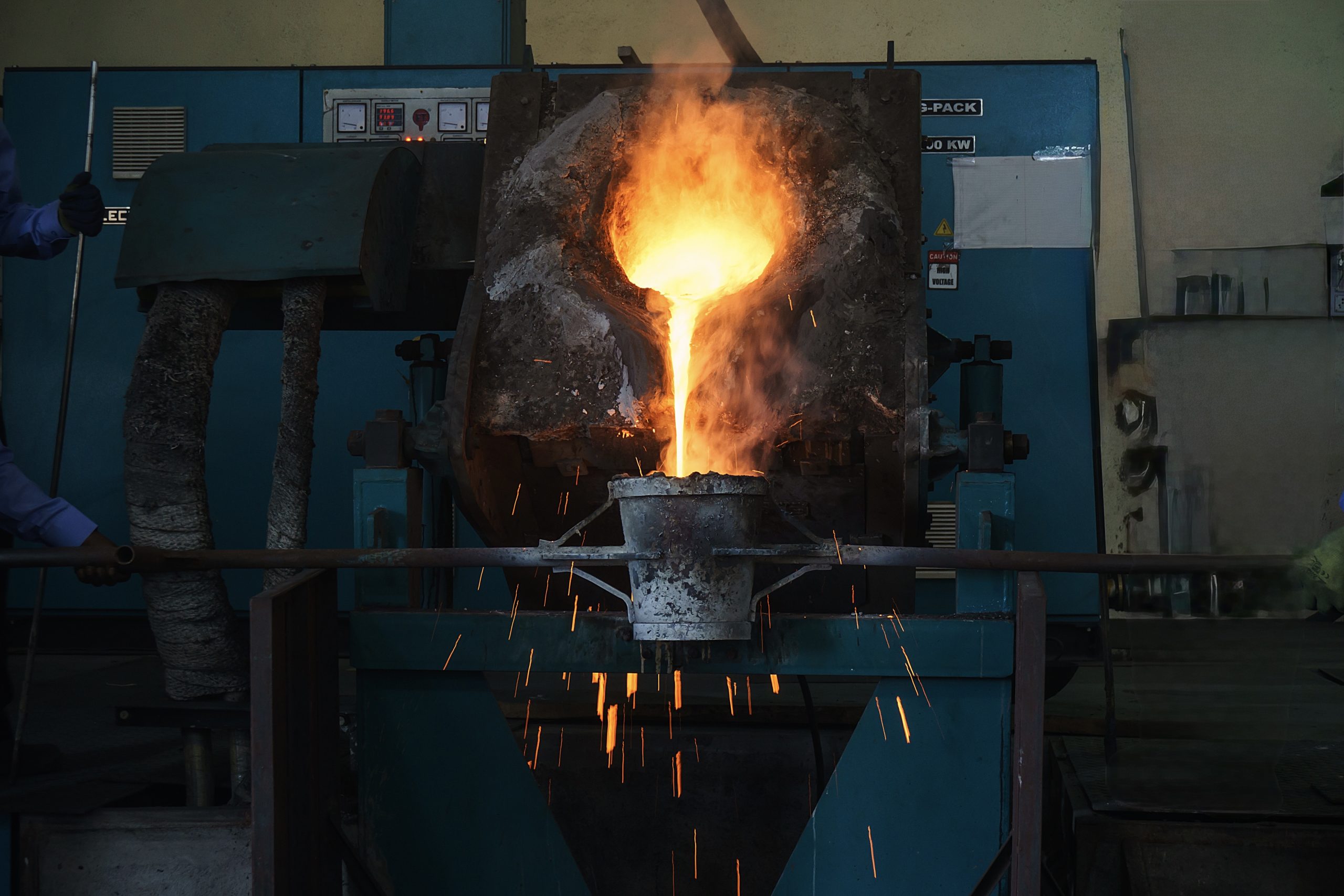
Metal casting is an ancient, yet essential, manufacturing process that involves pouring molten metal into a mold cavity and allowing it to cool and solidify into a desired shape. This method is crucial for creating complex parts across almost all industries, including automotive, aerospace, and construction.
The Fundamental Steps in Metal Casting
While various casting methods exist, the basic process typically follows these core steps:
-
Pattern Making:
-
A pattern is created, which is an exact (or slightly larger, to account for metal shrinkage) replica of the finished part’s exterior.
-
Patterns can be made from materials like wood, plastic, wax, or metal, and are used to form the mold cavity.
-
-
Mold Preparation:
-
A mold is created using the pattern. This mold contains the negative impression, or cavity, into which the metal will be poured.
-
For parts requiring internal spaces or holes, a separate component called a core is also placed within the mold cavity.
-
Molds are broadly categorized into:
-
Expendable Molds: Used only once (e.g., sand, plaster, ceramic).
-
Non-Expendable (Permanent) Molds: Reusable, typically made from metal or graphite.
-
-
-
Metal Melting and Pouring:
-
The chosen metal (or alloy, like aluminum, iron, steel, or bronze) is heated in a furnace until it reaches its molten (liquid) state.
-
The molten metal is then carefully poured into the mold’s cavity through a system of channels called the gating system (which includes the sprue, runners, and gates). Pouring must be done carefully to prevent defects like trapped gases.
-
-
Solidification and Cooling:
-
Once in the mold, the liquid metal is allowed to cool and solidify, taking the shape of the mold cavity. This process involves metal shrinkage, which must be accounted for in the initial pattern design.
-
-
Casting Removal (Shakeout):
-
After solidification, the solid metal part, called the casting, is removed from the mold.
-
For expendable molds, the mold is broken away. For permanent molds, the halves are separated and the part is ejected.
-
-
Finishing Operations:
-
The casting often needs final touches. This involves:
-
Trimming: Removing excess material from the gating system (sprue, runners, and risers) that solidified attached to the part.
-
Cleaning: Removing residual mold material (like sand) from the surface.
-
Machining/Heat Treatment: Additional processes may be used to achieve precise dimensional tolerances or enhance mechanical properties.
-
-